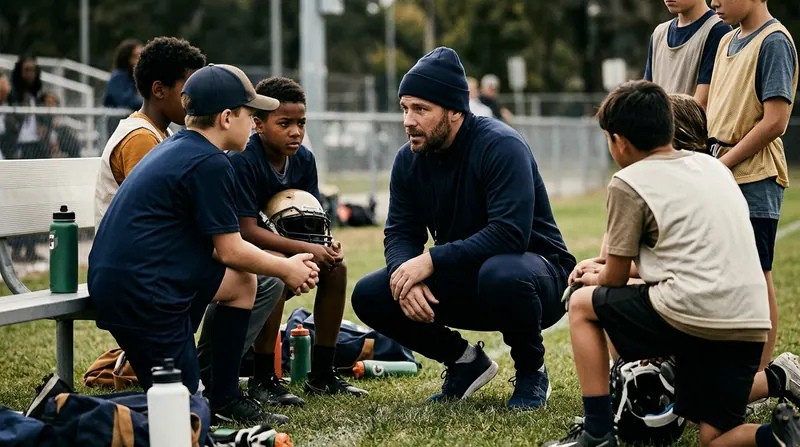
Five minutes before practice, one kid is half-taped and looking for a glove. Two are taking wild last-second shots at the wrong net. One is retelling lunch drama like the team meeting already started. And you’re standing there with a whistle, trying to decide whether to raise your voice or wait for the group to drift in.
That little window matters more than coaches think.
If the first three minutes belong to nobody, practice starts twice. Once when kids physically show up, and again when you finally get their attention. That gap is where energy leaks out.
I learned this the hard way over a lot of seasons. You can build a great practice plan on paper and still lose the feel of the session before the first drill starts. Not because kids are bad. Because unclaimed time turns into nonsense fast. Especially with youth teams. If there’s empty space, somebody fills it with wandering, ball hogging, side conversations, or that one fake wrestling match that somehow starts every Tuesday.
The fix is simple: give your captains the first three minutes of practice.
Not a speech. A job.
This is not about making a captain feel important. Kids can smell fake leadership jobs from a mile away.
This is about handing two or three players a repeatable opening routine that gets the team settled before you ever talk.
Your captains handle the same three things every practice:
- Get everyone to the starting spot
- Make sure gear is off the ground and out of the way
- Start the first simple movement or ball routine
That’s it.
No motivational talk. No mini-coaching clinic. No trying to sound like a college pregame speech in a public park.
Just a clean start.
What it looks like in real life
Pick one starting area. Same place every time.
When players arrive, captains are there first or get there fast. Their job is to pull the group in and get practice moving without waiting for you to drag everybody together.
Depending on your sport, that first three-minute routine might be:
- Jog to the line, bags to the fence, partner up and start short passing
- Helmets down, water behind the bench, form two lines and begin footwork
- Sticks on the sideline, pinnies sorted, start quick touch work in the box
The exact activity matters less than the consistency.
You are trying to erase the dead time between arrival and engagement.
Kids do better when the beginning feels known. Coaches do better when they aren’t burning their voice on organization before teaching even starts.
Micro thought: A good practice starts before the first instruction.
Why captains should own it
Because players listen differently to teammates in that moment.
Not always better. Just differently.
When a coach calls everyone in, some kids hear correction before you’ve even corrected anything. When a captain says, “Grab a partner, let’s go,” it feels more like team flow than adult interruption.
I’ve seen this especially with middle-school groups and young high-school teams. They don’t need more noise. They need one or two peers setting the temperature early.
And here’s the other benefit: it teaches leadership where leadership actually lives. Not in the game-winning speech. In the ordinary habit of getting people moving on time.
That’s real captain stuff.
How to introduce it without making it awkward
Keep it plain.
Tell your captains something like:
“Your job is to own the first three minutes. Get the team to our start spot, clean up the gear mess, and begin the opening routine. I’ll handle coaching. You handle the start.”
Then tell the team:
“When practice begins, follow the captains into the opening routine. Same start every day unless we tell you otherwise.”
Short. Clear. Repeatable.
Don’t oversell it. The more dramatic you make it, the more performative it becomes.
Common mistake coaches make
They interfere too fast.
If you give captains the first three minutes, let them actually have it.
That doesn’t mean you disappear. It means you stop jumping in over every tiny thing.
If a line is a little crooked, let it be crooked for 20 seconds. If one kid needs a second reminder, let the captain give it. If the ball work starts a little clunky, resist the urge to grab control just because silence makes you itchy.
Too many coaches say they want player leadership, then step on it the second it’s imperfect.
Messy ownership is still ownership.
Micro thought: If kids never carry the routine, they never learn how.
Who should be captain if your best player isn’t built for it
Not every captain has to be your star.
Sometimes your best choice is the kid who is early, steady, and not afraid to say, “Let’s go.” Sometimes it’s the player who remembers where equipment belongs. Sometimes it’s the one who doesn’t talk a lot but always does the next right thing.
I’ve had teams where the emotional leader and the skill leader were not the same kid. That’s normal. Pick the players who can create order without making the room weird.
What changes when you do this well
Practice feels less like a roundup and more like a team.
You stop wasting your first coaching bullets on avoidable stuff. Kids stop acting surprised that practice has started. Your warm-up has a pulse before your whistle ever enters the picture.
And maybe most important, your captains stop thinking leadership means talking after mistakes or cheering after goals. They start understanding that leadership often looks like getting everyone where they need to be before the real work begins.
That’s the kind of habit that carries into games, benches, huddles, and bad stretches.
The first three minutes are small until you coach enough teams to know they’re not small at all.