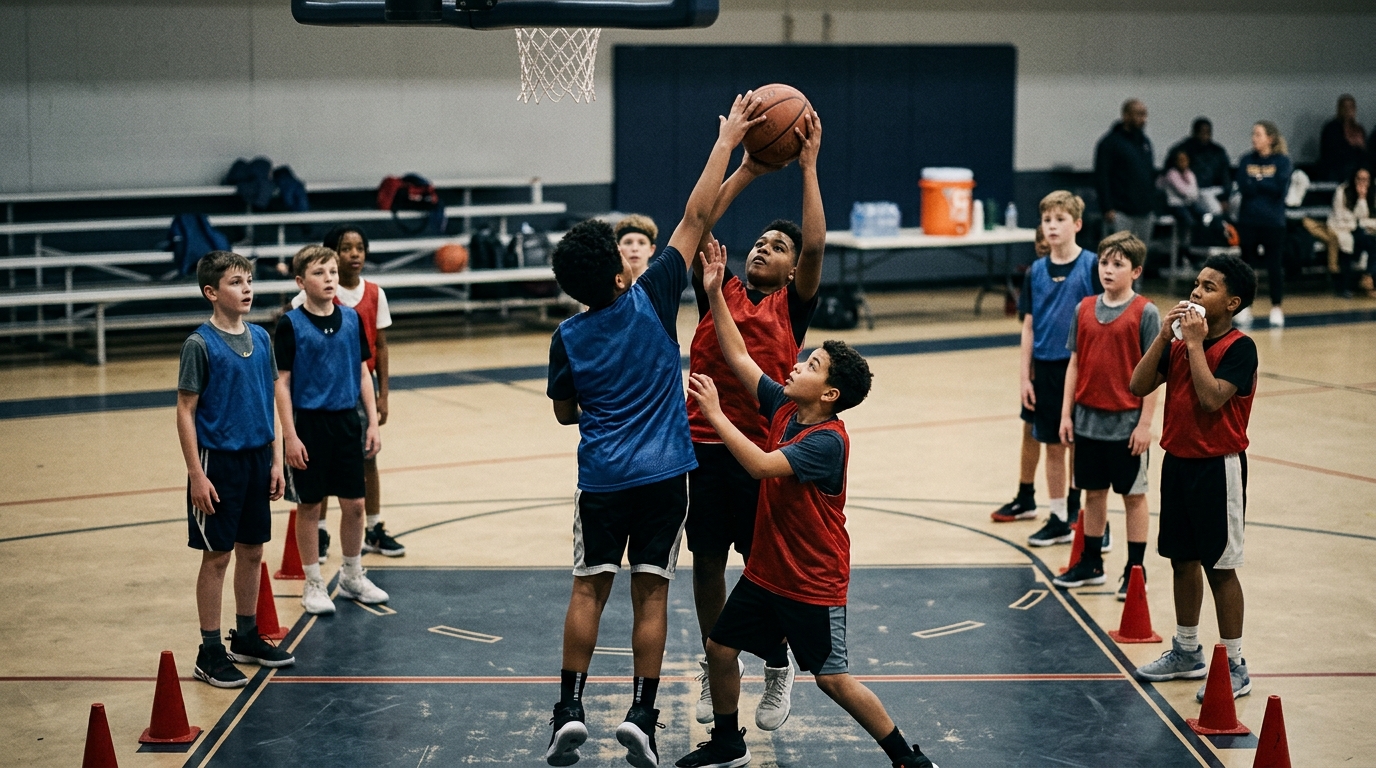

Three kids were already sprinting. Two were tying shoes. One had a water bottle open and upside down. Another was kicking a ball at the fence because nobody had told him not to yet. Practice had technically started, but nothing useful was happening.
That’s a pretty normal youth sports beginning when everybody arrives from a different day. School brain. Snack brain. Sibling-in-the-car brain. Parents still calling out reminders from behind the bench. Coaches digging for pinnies like the bag owes them money.
When a team shows up scattered, the answer is not a longer speech. It’s a simple reset drill that gets bodies moving, eyes up, and ears open without making kids stand still pretending to listen.
The one I keep coming back to is the 4-cone reset drill.
It’s not fancy. That’s the point. It works in a gym, on grass, on dirt, on a blacktop, and with almost any age group. You can run it with a ball, a puck, or no equipment at all. Most importantly, it gives you a clean way to start practice before the real teaching begins.
What it looks like
Set four cones in a square, about 8 to 12 yards apart for younger kids and 12 to 18 for older ones. One athlete starts at each cone. If you have more than four kids, make short lines behind each cone.
Then run players through a quick series of movement calls as they travel cone to cone.
- Jog forward
- Shuffle right
- Backpedal
- Shuffle left
- High knees
- Skip
- Open hips and turn
- Sprint one side, recover the rest
If your sport uses equipment, add it after the first round. Dribble through it. Carry and pass at each cone. Catch, turn, and move. Keep it simple enough that the first success comes fast.
Why this drill settles a team down
I learned a long time ago that kids don’t usually need to be “amped up” for practice. They need to be organized. Those are not the same thing.
A square of cones gives them instant structure. There’s a place to stand. A direction to move. A turn coming soon. No mystery. No dead space where side conversations grow.
And because the pattern repeats, you can coach on the fly without stopping the whole group every ten seconds.
Movement first. Corrections second.
That order saves practices.
How to run it in 6 to 8 minutes
Round 1: Learn the shape
Send them around the square with one basic movement pattern. Just get traffic flowing. Fix spacing if kids are stacked on top of each other.
Round 2: Add direction changes
Now change movement at each side. Forward, shuffle, backpedal, shuffle. Keep your voice calm and your instructions short.
“Eyes up.”
“Stay outside the cone.”
“Don’t pass the person ahead of you.”
Round 3: Add a sport action
Basketball? Dribble weak hand on one side, strong hand on the next. Soccer? Two touches between cones. Baseball or softball? Break down into fielding position at each cone and simulate first-step movement. Hockey? Stickhandling with head up if space allows.
Round 4: Compete without making it chaos
Give them a clean challenge that keeps form in place.
- How many perfect laps in 45 seconds?
- Can every player finish without a dropped ball?
- Can each line keep proper spacing the whole round?
You want urgency, not a demolition derby.
Common mistake coaches make with it
They explain too much before the first rep.
You do not need a clinic-level demonstration for a square. Put kids in motion, then tighten it up. If you wait for perfect understanding before anybody moves, you’ll spend the first eight minutes managing boredom instead of building rhythm.
Another mistake is stretching the drill too long because it’s going well. Don’t marry the warm-up. Once the team looks connected, move on.
The job of the reset drill is to create a practice you can coach.
It is not the whole practice.
How it helps the rest of your session
After a good 4-cone reset, your next activity usually starts cleaner. Lines form faster. Transitions get shorter. Instructions land better. You’ve already established pace, spacing, and the expectation that everybody moves when practice starts.
That matters more than most coaches think.
I’ve had plenty of practices where the best coaching decision wasn’t some brilliant drill adjustment. It was making the first few minutes less sloppy. Kids feel that difference right away. So do assistants. So do parents watching from the sideline, especially the ones who can tell when a group is drifting.
There’s a big difference between loud and ready.
Best times to use it
- At the start of practice when arrivals were messy
- After a long break in the schedule
- When energy is flat and kids need movement fast
- Before a technical station that requires attention
- With mixed-skill groups who need an easy shared entry point
Keep it boring in the best way
Kids do not need a brand-new opening every practice. They need one they recognize. Familiar structure lowers nonsense. It also lowers the amount of coaching volume you need.
That’s a good trade.
If your team keeps starting practice like a garage sale, build the square, get them moving, and let the first win of the day be simple: everybody doing the same thing at the same time.
That sounds small until you coach a team that can’t do it yet.