
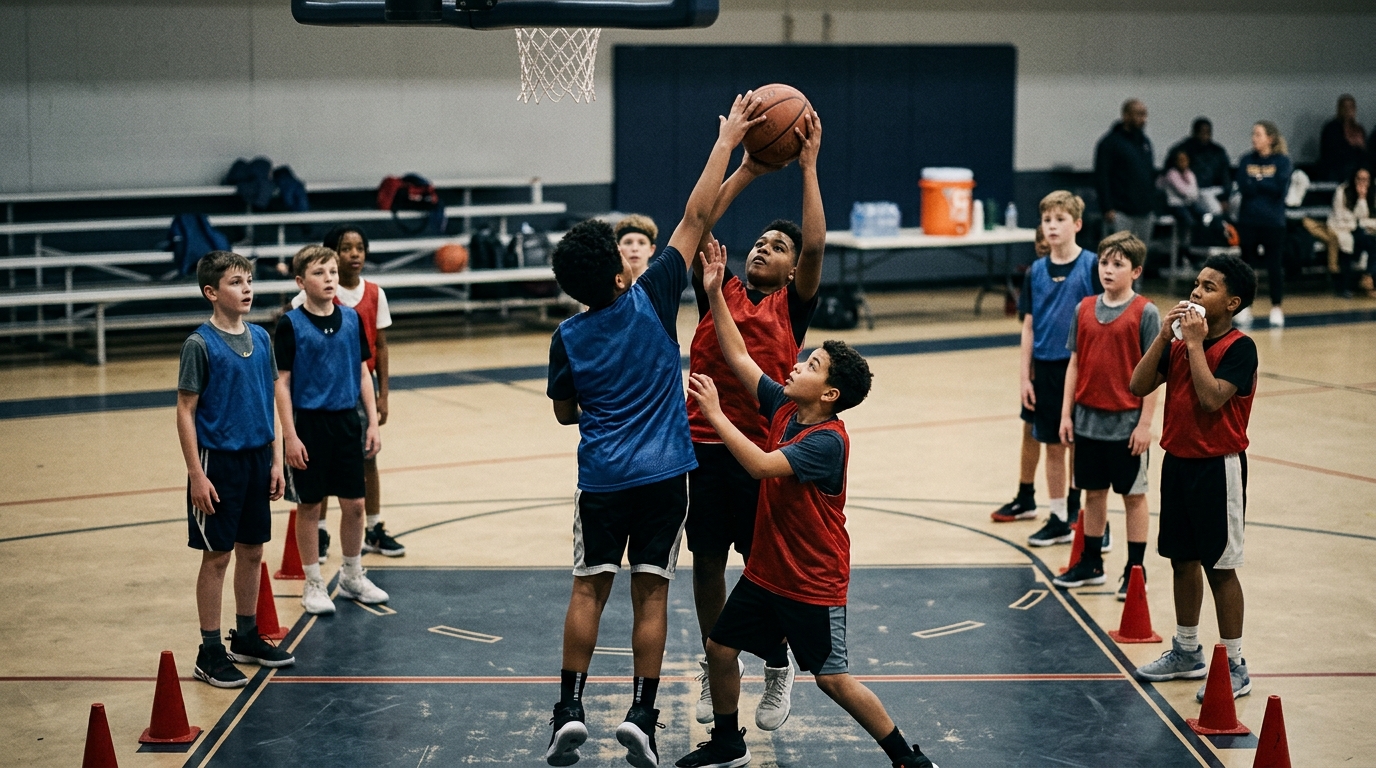
Ball goes up. Three kids stare. One kid jumps. The same kid gets every rebound for six straight possessions while everybody else waits for a coach to explain “want-to” again.
I’ve seen that movie a lot.
Usually the coach means well. They stop practice, talk about effort, talk about being physical, talk about pursuing the ball. The problem is kids don’t learn rebounding from a lecture. They learn it from a drill that makes the first move obvious and the second effort unavoidable.
That’s where the two-line rebound drill earns its keep.
It’s simple, fast, and useful for way more than rebounds. It teaches contact, balance, timing, and going again after the first jump doesn’t work. It also cleans up one of the biggest youth-sports habits there is: watching the ball and hoping it lands kindly.
What it looks like
Put two lines near the lane, one on each side. First player in each line steps into the paint. Coach stands in front with a ball.
Toss the ball off the backboard. Not a soft little rainbow. Throw a miss that comes off with some life.
On the toss, both players fight to secure the rebound. Whoever gets it must chin the ball, pivot strong, and make an outlet pass to the next player in line. Then both players switch lines.
That’s the base version. Nothing fancy. That’s the point.
Why this one works
When I was younger and coaching early, I made rebounding too complicated. I’d stack rules on top of rules. Find, hit, turn, pursue, secure, outlet. All true. Too much at once for most kids.
What I learned after enough loud gyms and enough rushed practices is that young players need one clean fight they can understand. Me, you, ball, go get it.
This drill gives them that.
It also reveals a lot fast. You find out who avoids contact, who jumps too early, who brings the ball down to their waist, and who quits after the first tip. That’s real practice gold. Not because you can call them out, but because now you know what to teach.
Micro thought: Kids usually don’t need a better speech. They need a cleaner rep.
How to run it well
1. Keep the lines short
If you’ve got ten kids in each line, half the group is doing theater. Keep it moving with multiple baskets if you can. If you only have one hoop, run quick rounds and rotate constantly.
2. Toss game-like misses
High off the glass. Hard off the rim. Slightly to one side. If every rebound drops right in the middle, you’re teaching timing but not pursuit.
3. Demand the finish after the rebound
Don’t let the rep end at the catch. Secure it. Elbows out naturally, not swinging. Chin it. Pivot. Outlet. A lot of youth turnovers happen after the good part. They finally get the ball, then hand it right back.
4. Coach one thing at a time
For one round, coach first contact. Next round, coach two hands. Next round, coach landing wide and balanced. If you correct five things per rep, kids hear none of them.
5. Make the second jump matter
If the ball gets tipped, the play is still live. Some kids are great on the first leap and invisible after that. Rebounding belongs to the player who stays with it longest.
Simple progressions
- Box-out first: On the toss, players must make contact before pursuing the ball.
- Score it: One point for a clean rebound and outlet. First line to seven wins.
- Add a finish: Rebounder secures the ball, outlets, then sprints to the front of the rim for a return pass and layup.
- Make it uneven: Start one player slightly behind to teach pursuit from a disadvantage.
You don’t need all of these in one practice. Pick one. Run it hard. Move on.
Common mistakes coaches make
The biggest one is letting the stronger kid dominate every rep against the same weaker kid. That’s not development. That’s a demonstration.
Mix your matchups.
Another mistake is allowing lazy tosses because the coach is tired or distracted. The quality of the rep starts with the quality of the miss. If the toss stinks, the drill stinks.
And don’t leave kids in there forever. This is a contact drill. Short bursts keep the intensity honest.
Micro thought: If the line is long, the lesson gets short.
Where it fits in practice
I like this drill after the warm-up and before bigger team play. Kids are loose enough to compete, but not so gassed that every rebound turns into falling and flailing.
Give it 6 to 8 minutes. That’s enough.
Longer than that, the technique usually slips and the collisions get sloppier. Shorter than that, some kids are just starting to understand the rep when you blow the whistle.
If rebounding has been hurting you in games, come back to it twice a week for a stretch. Not forever. Just long enough that the habit changes.
What you’re really teaching
Yes, you’re teaching rebounding. But you’re also teaching kids that effort has a shape.
It’s not just “play harder.” It’s hit first, pursue, secure, and finish the possession.
That matters because young players hear “be aggressive” all the time. Most of them still don’t know what that means in a playable way. This drill gives them a version they can repeat.
And once they can repeat it in practice, you’ll start seeing it in games. A kid who used to wait under the basket starts making first contact. A kid who used to tip it once starts going back up again. A team that gave away extra possessions starts ending them.
That’s usually how improvement shows up. Not with a big breakthrough speech. With one drill, done clean, until the gym starts to look different.


