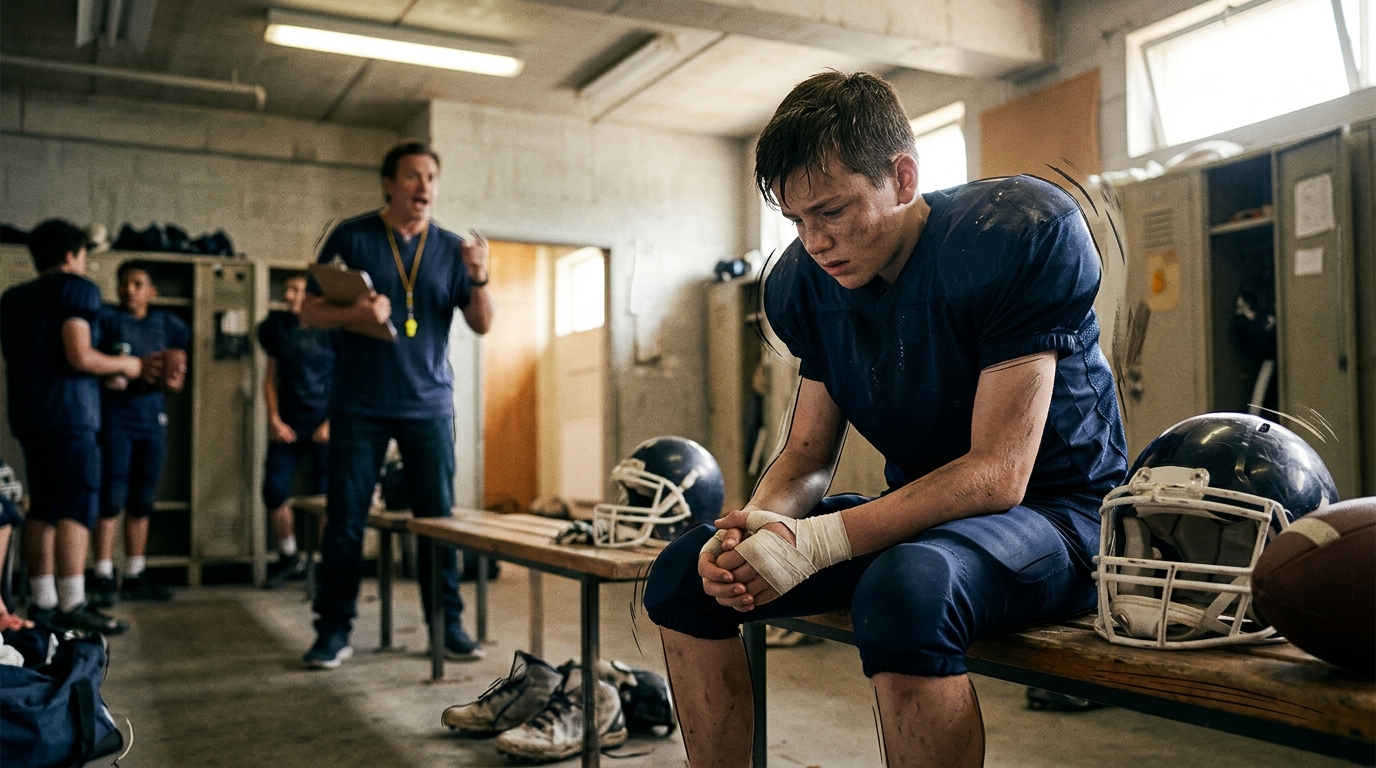

You know the moment. You bobble a routine ball. Miss a layup you make 99 times in warmups. Drop a pass, turn it over, swing at ball four, miss a block, take a bad penalty. You hear that one sound right away — the crowd noise changes, your teammates glance over, and your own brain gets loud fast.
Then the dangerous part starts. Not the mistake. The spiral after it.
I’ve seen it from every angle. A player boots one grounder, then rushes the next one because now they’re trying to “make up for it.” A defender gets beat once, then starts lunging at everything. A guard throws one bad pass, then spends the next three possessions playing scared. One error turns into five because the body stayed in the game, but the mind got stuck on the last play.
Here’s the truth: acting like you don’t care isn’t toughness. Usually it’s the opposite. If the mistake mattered to you, it should sting a little. That’s normal. The goal is not to feel nothing. The goal is to reset fast enough that the mistake only costs you one play.
You need a routine. Not a speech. Not magic. A routine.
Your mid-game reset
1. Have a physical flush.
Do something short and repeatable right after the mistake. Exhale hard. Tug your glove strap. Clap once. Wipe your hands on your shorts. Tap your chest. Turn and jog to your spot. It sounds small, but that’s the point. Your body needs a cue that says, “That play is over.”
Good players use little resets all the time. Not because they’re robots. Because when adrenaline spikes, simple beats fancy. Pick one move and use it every time. If you only try to reset when you’re already melting down, it won’t feel natural.
2. Give yourself one line, not a whole conversation.
After a mistake, your brain loves speeches. Usually bad ones. “I can’t believe I did that.” “Coach is pulling me.” “Now everyone thinks…” None of that helps you play the next rep.
Use one short instruction instead. Something playable. Something your body can do.
Examples:
“Eyes up.”
“Set my feet.”
“First touch strong.”
“See ball, make play.”
“Next job.”
Notice what those are not. They’re not fake hype. They’re not “I’m the best.” They’re cues. Simple directions shrink the moment back down to size.
3. Find the next tiny win.
You do not need to erase the mistake with a hero play. That’s where players get into trouble. One turnover leads to forcing the next pass. One strikeout leads to chasing in the field. One missed shot leads to taking another bad one because you’re desperate to prove you’re fine.
Don’t hunt a miracle. Hunt one solid rep.
Maybe it’s calling the ball loudly. Sprinting back on defense. Getting into help position early. Making the easy pass. Winning your assignment for ten seconds. A clean first touch. A hard cut. A loud screen call. Something simple and correct.
This is how you stop the leak. Not with drama. With details.
I’ve coached players who thought bouncing back meant pretending the mistake never happened. Usually everybody could tell they were rattled anyway. The better competitors were the ones who looked annoyed for about two seconds, reset, and got useful again. That’s real composure. Not fake smiling. Not slamming your stick or kicking dirt either. Just getting your mind back to work.
And yes, sometimes adults make this harder. A coach who screams the same point you already know, or a parent who keeps reacting from the sideline, can pour gas on a player who’s already frustrated. That’s real. But even then, your best move is still the same: get your attention onto the next job. You don’t control the noise. You do control where your eyes, feet, and focus go next.
One more thing: resetting is not the same as avoiding responsibility. If you messed up because your footwork was lazy or you didn’t communicate, own that. Fix it. Learn it after the game. But mid-game is not the time for a full emotional documentary. Mid-game is for competing.
So build your sequence: physical flush, one cue, one small win. Practice it when the stakes are low so it’s there when the game gets loud.
You’re going to make mistakes. Everybody good does. The players who stay playable are not the ones who never mess up. They’re the ones who don’t let one bad moment start driving the car.
That’s the honest version. You can care. You can be mad. Just don’t let the last play steal the next one too.