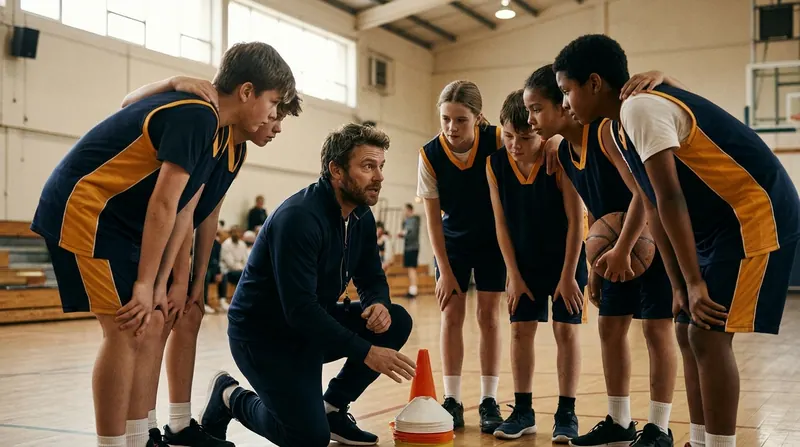
Halfway through practice, the drill had gone mushy.
Kids were cutting the corner early, one was arguing that last rep didn’t count, and two more were doing that thing where they stare at you like the instructions changed in another language. The assistant started re-explaining. A player in the back asked, “Wait, are we still doing one touch?” You could feel five good minutes slipping right through the whistle.
That’s the moment a lot of coaches start talking more. I’ve done it too. Bigger voice. Longer explanation. One more full-group reset because surely this time everybody will lock in.
Usually, they don’t.
What helps more is simpler than that: when the rule changes, put the change on a cone, a spot, or a visible marker instead of trusting a speech to carry it.
Kids miss verbal changes all the time
Not because they’re disrespectful. Not because they don’t care. Because practice is noisy, kids arrive to instructions at different times, and half your team is still finishing the last rep in their head when you start explaining the next one.
I learned this the hard way running small-sided games and skill stations. I’d tweak one condition to get the behavior I wanted—two dribbles max, weak hand only, field through the left gate, pass before shot, whatever—and I’d announce it once like I was delivering law from the mountain.
Then the first three kids who heard me would do it right, the next four would guess, and the rest would copy whoever looked most confident.
That’s not a focus problem. That’s a delivery problem.
Visible rules travel better than spoken ones.
What this looks like in real practice
Let’s say you’re running a soccer possession box and you want to switch from free play to two-touch. Don’t just yell, “Two-touch now!” while the ball is rolling.
Set a bright cone just outside the grid before the drill starts and tell them one thing: if the blue cone is up, we’re two-touch.
Now the rule has a home.
Same idea works everywhere:
- Basketball: a ball on the sideline means no dribble on this round.
- Baseball/softball: a helmet on the bucket means every rep ends with a hard turn at first.
- Volleyball: a cone by the net means pass-set-free ball only, no attacks.
- Lacrosse: a pinnie on the goal means you must complete one pass through X before shooting.
You’re not creating some elaborate code system. You’re just giving the adjustment a visible flag.
When a kid forgets, you don’t need a full stoppage. You just point. “Check the cone.” That’s cleaner than another lecture and a lot less personal than calling them out like they weren’t listening.
Why this works better than repeating yourself
Because repeating instructions usually punishes the kids who were already doing it right.
That’s one of those little practice-management mistakes coaches make without noticing. We stop everybody to fix the few. The pace drops. The sharp kids get bored. The distracted kids get an extra rest break. Nobody wins.
A visible marker lets the drill keep moving while the rule stays available.
And it changes your correction style for the better. Instead of, “How many times do I have to say it?” you get, “Blue cone. Two-touch.” Short. Neutral. Back to work.
Don’t make kids hold your whole practice in their memory when you can put part of it in the space.
Keep the system small
This only works if you don’t turn it into airport signaling.
Use one or two visible cues, not eight. The goal is less confusion, not a scavenger hunt. If every color means something different and every station has its own language, now they need a decoder ring just to compete.
Pick cues you can use consistently:
- One cone color for touch or possession limits
- One object for finish-the-rep conditions
- One spot that tells the waiting group where to look for the active rule
That last part matters. If the cue lives in a different place every time, you’re right back to chasing attention.
Consistency beats cleverness in youth practice.
It also helps assistants coach the same drill
This is the sneaky good part.
When the rule is visible, your assistant doesn’t have to remember your exact wording or reinterpret the emphasis on the fly. They can reinforce the same thing with the same cue. That keeps one side of the drill from playing by Tuesday’s rules while the other side is somehow on Thursday.
I’ve been on both ends of that. Nothing gums up a practice faster than adults teaching two versions of the same rep from ten feet apart.
The cone doesn’t solve everything, but it cuts down the drift.
Use your voice for teaching, not traffic control
There’s a difference between coaching and constant directing. If your whole practice depends on you narrating every adjustment live, your voice gets spent on logistics instead of actual teaching.
Save the talking for the part that matters most: effort, timing, decision-making, body position, teammate habits, game sense.
Don’t waste it on six rounds of “No, the other rule now.”
Some of the best practices feel clear not because the coach talks nonstop, but because the environment does some of the work.
That’s the real move here. Build a practice where kids can look around and find the rule.
When the drill changes, put it somewhere they can see.
Then coach the rep instead of chasing the confusion after it.