
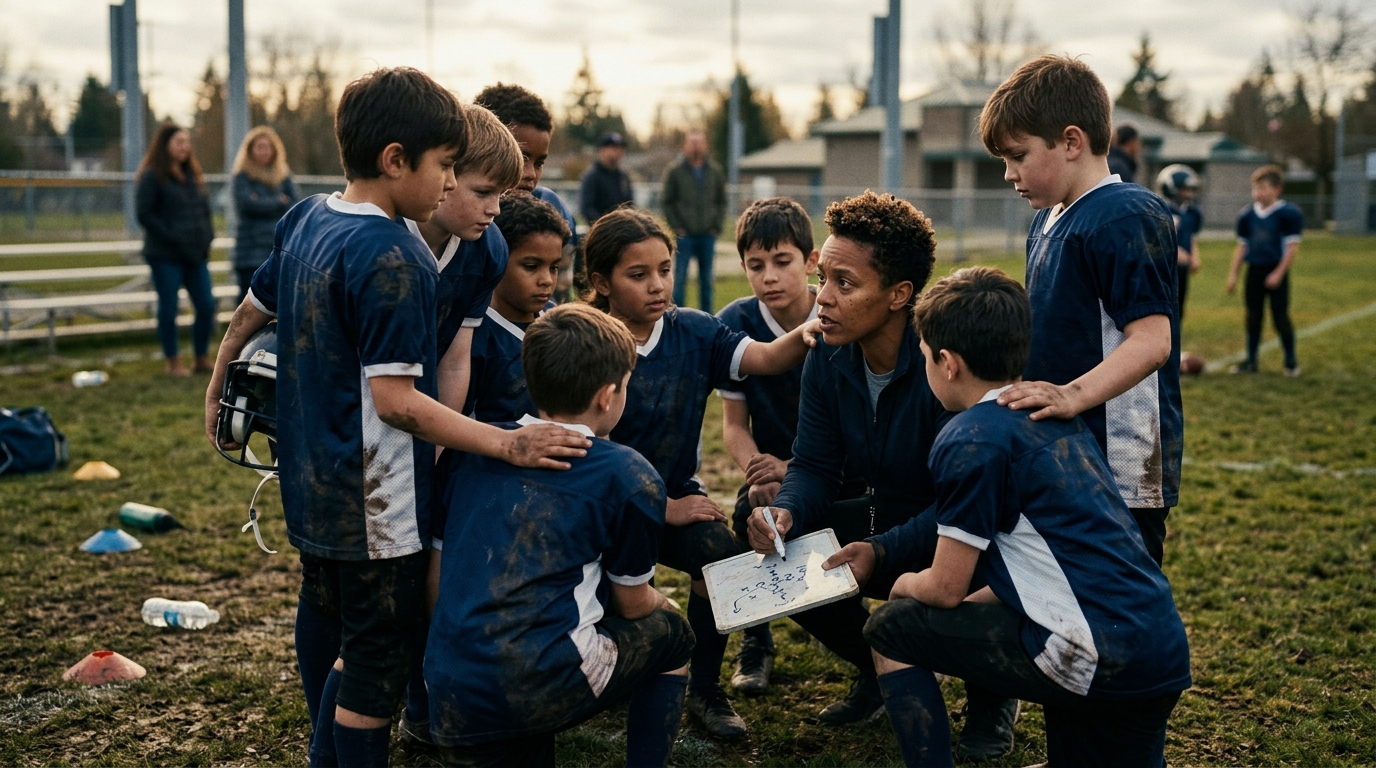
Three minutes into the second half, your team gets the ball back and immediately looks like ten people trying to merge into one lane. One kid sprints. One kid points. Two kids ask who’s taking it in. The player with the ball holds it a beat too long, forces something crowded, and now you’re jogging back on defense while your bench asks, “What are we doing?”
That moment is not usually a hustle problem. It’s not always a skill problem either. A lot of times it’s a clarity problem. Kids can play fast once they know what fast is supposed to look like.
I learned this the hard way after too many stretches where our team looked organized in dead-ball moments and completely scattered once play restarted. We had practiced. We had covered spacing. We had talked through options. But in live action, the kids were still trying to solve everything at once. That’s a lot to ask from young players.
One small coaching move cleaned up more of that mess than any long speech ever did: before the restart, name the next three plays.
Not every detail. Just the next three decisions.
This works in just about every sport because kids don’t need a full game lecture in the middle of a game. They need a short runway.
It sounds like this:
- Basketball: “First trip, swing it and get to the corner. Next trip, screen away for Mia. Third one, if they trap, outlet middle.”
- Soccer: “First ball wide. Second ball back to support. Third chance, look through the middle if it’s there.”
- Lacrosse: “First possession, settle. Next one, dodge from up top. Third one, back it out if it’s crowded.”
- Baseball/softball dugout: “First batter, make them field it. Next hitter, move the runner. Third one, stay gap to gap.”
You’re not scripting the whole game. You’re reducing noise. Young athletes play better when the picture gets smaller.
Why it works
Most youth players don’t fall apart because they forgot everything you taught. They fall apart because too many choices show up at once.
When you name the next three plays, a few good things happen:
- The first decision comes faster.
- The bench and the field hear the same plan.
- Your leaders have language they can repeat.
- Mistakes don’t feel like total chaos because there’s still a next action.
That last part matters. Kids can recover from a bad possession or a sloppy rep if they know what comes next. What rattles them is the feeling that every mistake means the whole team is now freelancing.
Clear teams look calmer than they feel.
When to use it
Not on every whistle. Not before every snap, pitch, or possession. If you overdo it, they stop owning the game and start waiting for your next instruction.
Use it when the group looks sped up, unfocused, or disconnected. Good times include:
- right after halftime
- after a timeout
- after giving up a quick run of points or momentum
- when substitutions changed your shape or chemistry
- when the game is getting louder and your team is getting less decisive
You’re basically telling the team, “Here’s the next stretch. Settle in.”
How to say it so kids actually keep it
Short words. Same order. No extra paragraph at the end.
If you give the team three plays and then add six warnings, two motivational lines, and a side note for one player, the whole thing is gone. Keep it clean.
A good sequence sounds like this:
“Next three: wide, support, attack.”
Or:
“Settle, reverse, then go.”
Or:
“Strong first pass, talk early, finish under control.”
If needed, attach names: “Jayden starts it. Ava talks the shape. Leo looks middle.” Now the plan has owners.
I’ve seen young teams respond to this almost immediately because it gives them a shared target without making them robotic. They still have to read the game. They just aren’t reading it alone.
What coaches get wrong
1. They explain instead of naming.
Midgame is not class time. Name the actions. Save the seminar for practice.
2. They make all three plays about scoring.
Sometimes the first play should just calm the group down. Possession, spacing, communication, field position—those count too.
3. They abandon it after one broken rep.
The first of the three might fail. Fine. Go to the second. Kids need to learn that structure survives an imperfect play.
4. They use it as control instead of support.
This is not barking orders to prove you’re involved. It’s a temporary bridge when the team needs help getting organized again.
If you talk so much they can’t think, you’re not helping.
What it teaches over time
At first, you’ll be the one naming the next three plays. Later, your captains will start doing it. Then your whole team gets better at settling itself.
That’s the real win. Not that they followed instructions. That they learned how to shrink a messy moment into a playable one.
You can see it when a team matures. A kid on the field turns and says, “Next one wide. Then drop it back. Then we go.” That’s not just communication. That’s composure.
And composure in youth sports usually doesn’t come from some big emotional speech. It comes from repeatable little habits that make the game feel less crowded.
When your team starts spinning, don’t give them the whole manual. Give them the next three plays, and let the game get simple again.