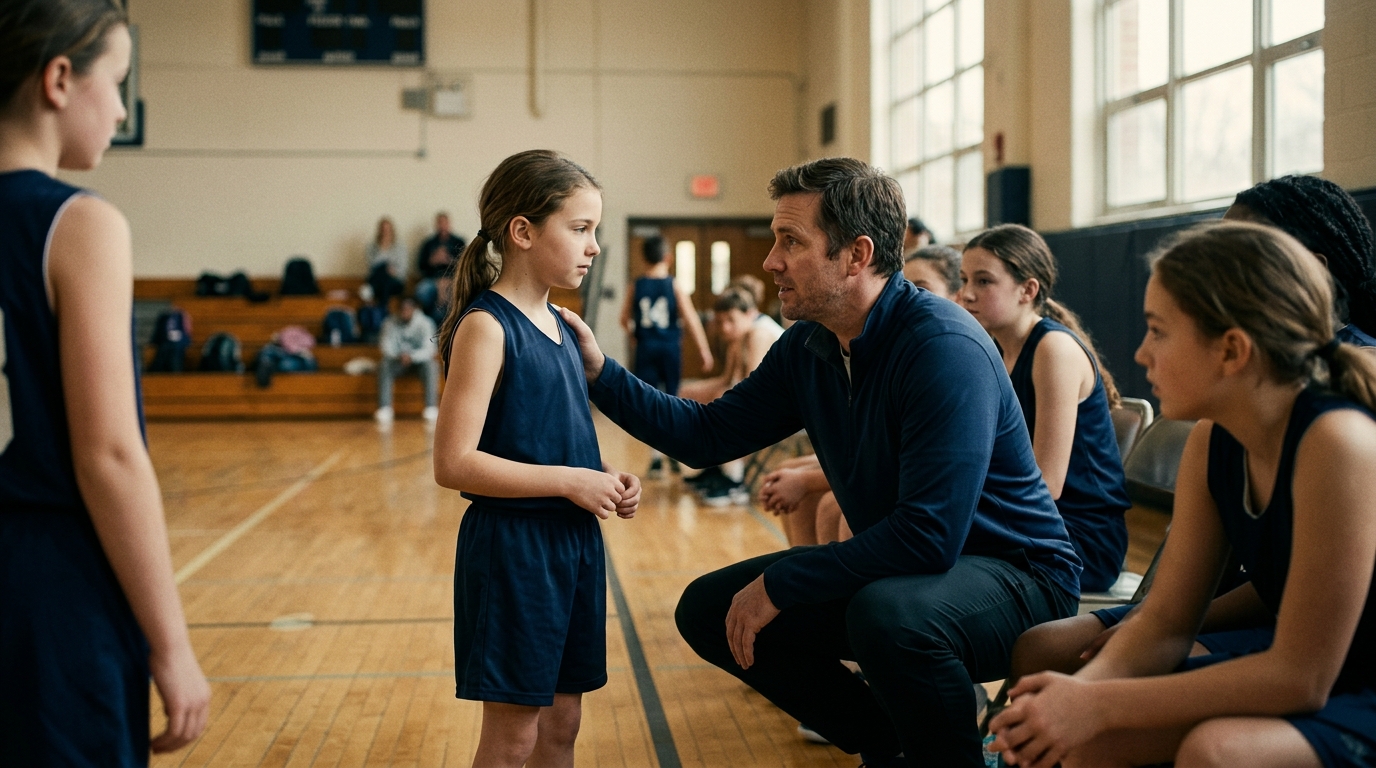

Halfway through practice, you can feel it happening.
You’ve got eight kids standing with gloves on, two more kneeling in the dirt drawing lines with a finger, and one staring at the sky like he’s waiting for weather. You’re still talking. You’re explaining the next drill for the third time because one kid asked where to stand, another missed the first sentence, and now everybody’s attention is leaking out of the huddle.
That’s the moment a lot of practices get slower than they need to be.
I’ve done it too. Most coaches have. You want the drill to run clean, so you keep adding words. One more reminder. One more coaching point. One more “just so everybody knows.” Meanwhile, the reps haven’t started, and kids learn sports by doing, not by listening to a perfect speech.
One of the best practice decisions you can make is this: stop trying to explain the whole drill before it starts. Give them enough to begin. Teach the rest on the move.
Kids do not need the full manual
Coaches forget this because adults like complete instructions. Kids usually need three things:
- Where to start
- What to do first
- Where to go next
That’s it.
If you give them all the possible rotations, mistakes, teaching points, and exceptions before the first rep, you lose the group before the drill ever helps them.
Practice is not a meeting.
If I’m setting up a fielding drill, I don’t need a two-minute explanation. I need: “Ball starts here. Field it out front. Throw to first line. Follow your throw.” Then we go. If the footwork is messy, I fix footwork after two reps. If the line is crooked, I move the line. If they’re flipping balls when they should be throwing, I stop that piece and clean it up.
That works better than giving a TED Talk next to a bucket of baseballs.
The rule I wish more coaches used
Try this: explain for 20 seconds, demo for 10, start the drill.
Not every single time, but most of the time.
If your explanation is stretching past that, there’s a decent chance the drill is either too complicated, too crowded, or trying to teach too many things at once.
That last part gets coaches all the time. We build one drill to work on fielding, communication, footwork, decision-making, hustle, and accuracy. Then we’re surprised it takes forever to explain and falls apart in 30 seconds.
Usually the problem isn’t the kids. The problem is the drill has too many jobs.
If you need a paragraph to explain it, it probably needs a haircut.
What to say instead
Short language helps practice move. It also makes you sound calmer and more confident.
Instead of:
- “Okay, so what we’re going to do here is work on getting behind the ball and staying low and making sure we’re using proper footwork, and then after that I want you to look where you’re throwing before you just rush it…”
Try:
- “Get behind it. Stay low. Quick throw.”
Instead of:
- “Everybody pay attention because after you go through this side you’re actually rotating to the other line unless Coach sends you back, which depends on where the ball ends up…”
Try:
- “Go here. Then there. Watch the coach.”
That’s not dumbing it down. That’s coaching clearly.
The younger the group, the more this matters. But honestly, older kids benefit too. Even good players drift when a coach talks too long. They just hide it better.
Fix it live, not all at once
The fear behind over-explaining is real. Coaches think, If I don’t cover everything now, the drill will look sloppy.
It might. For a minute.
That’s okay.
Live reps give you something real to coach. Standing still gives you guesses.
Once the drill starts, now you can correct the part that actually needs correcting. Not the five things you were worried might happen. That’s a better use of everybody’s time.
I’d rather see a drill start a little messy and improve fast than look organized in the explanation and die in the first thirty seconds.
There’s also a culture piece here. When kids know practice starts with action, they lock in faster. When they know every transition means another speech, they relax too much. Their bodies cool off. Their attention wanders. Your pace disappears.
Three ways to keep yourself from talking too much
1. Start with the first rep only
Don’t explain the full cycle. Explain what the first kid is doing.
2. Use one teaching point per round
If it’s a throwing drill, today’s point might be “front shoulder.” Not front shoulder, crow hop, grip, follow-through, and communication all at once.
3. Let the drill answer the question
When a kid asks something the rep will show in five seconds, just say, “You’ll see it.” Then begin.
Not every question needs a seminar.
What better practice sounds like
It sounds shorter.
“Watch this.”
“Your turn.”
“Good. Again.”
“Too tall. Get low.”
“Better.”
That kind of practice has life to it. Kids move. They adjust. They get more chances. And most of the time, behavior problems shrink when waiting and talking shrink too.
Coaches love to think the magic is in the perfect explanation. Most days it isn’t.
The magic is in getting to the rep faster.
Say less. Show a little. Start sooner.
You can coach a moving drill a lot better than a standing huddle.