Third inning of a Saturday game, ball skips foul, and six kids drift toward the dugout opening like moths to a porch light. One kid is asking if he’s on deck. Another is halfway into a helmet that isn’t his. Your right fielder has wandered close enough to hear every word from the parents. And now you’re trying to explain the next defensive look while nobody is actually in a spot to hear it.
That’s not a listening problem. That’s a location problem.
A lot of youth coaching gets blamed on focus when the real issue is traffic. Kids are not great at managing dead-ball space. If you don’t assign standing spots, waiting spots, and listening spots, they will invent their own. Usually badly.
I learned this the hard way years ago, back when I thought good energy could cover for sloppy organization. It can’t. If kids don’t know where their body goes, their brain goes with it. The practice gets louder. The game gets messier. And you start repeating yourself like you’re announcing delayed flights.
So now I make one decision early with every team: before I install much of anything else, I define the team’s home spots.
Home spots clean up a lot of fake chaos
A home spot is the default place a player returns to when the rep ends, the whistle blows, the ball gets away, or the coach needs eyes. Not glamorous. Very useful.
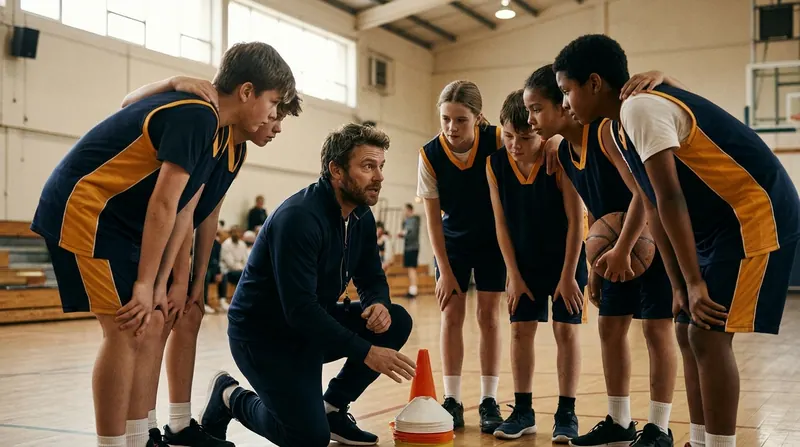
In basketball, it might be one foot on the sideline in front of the bench. In soccer, it might be a cone lane behind the drill. In baseball or softball, it might be helmet hooks, bat rack, then one clear bench rail or fence line by lineup group. The sport changes. The idea doesn’t.
Kids move better when they know where “done” is.
That matters more than coaches admit. A lot of transition slop comes from players finishing one thing and having no clue where to reset. So they orbit. They talk. They lean on equipment. They stand in somebody else’s lane. Then the coach jumps in with more words, which only stacks confusion on top of confusion.
If you want faster transitions, don’t just coach the drill. Coach the return.
Set the spot once, then protect it
This works best when you teach it like a team rule, not a suggestion you mention when annoyed.
At the start of practice, I’ll say something plain: “When you’re not in the rep, this is home.” Then I point to the exact place. I don’t give a speech about discipline. I just define the map.
Then we rehearse it. Quick rep, whistle, everybody back to home. Again. Ball rolls away, don’t chase unless your job is to chase; everybody else home. Again. One kid forgets, we reset it without drama.
That part matters. If home spots only show up when the coach is irritated, kids read it as punishment. If it shows up from the beginning, they read it as structure.
And structure beats volume every time.
What this fixes right away
- Mid-practice clumping. Kids stop crowding the action just because there’s a pause.
- Lost instructions. You know where to direct your voice, and they know where to receive it.
- Safety problems. Fewer kids wandering near bats, swings, throws, or live balls.
- Assistant coach overlap. Everyone can see who owns which group because the bodies are organized.
- Dead-time nonsense. Less drifting usually means less side chatter and less need for constant correction.
The big one, though, is this: it lowers the number of decisions kids have to make when they’re already learning something new.
Young players burn a lot of energy on simple uncertainty. Where do I put my glove? Am I up? Do I stay here? Do I go get a ball? Can I take a drink? If you answer those movement questions ahead of time, you leave more room for the actual skill.
That’s not being rigid. That’s being helpful.
Keep it visible, not verbal
Whenever possible, mark the home spot with something they can see. A cone line. A fence section. A bench segment. A chalk mark. Something physical beats something repeated.
Coaches often try to manage space by talking more. But kids don’t store spoken traffic rules very well once the gym gets loud or the inning gets weird. They need landmarks.
I’ve had teams where one orange cone saved me 20 reminders a practice.
Small thought: if you keep saying “back up, spread out, get off the line, give him space,” you probably don’t have a behavior issue. You have a layout issue.
Don’t overcomplicate the jobs around it
Once you create home spots, tie one or two simple defaults to them.
- At home spot, helmet off and eyes up.
- At home spot, glove on and ready for your turn.
- At home spot, take a knee only if coach is talking.
- At home spot, next two players prepare, everyone else stay clear.
That’s enough. You do not need a seven-part operating manual. The whole point is to reduce friction, not create a new ceremony.
The best team systems are boring on purpose. Boring systems hold up when kids are tired, excited, frustrated, or distracted by a sibling doing cartwheels behind the bench.
The real win is your voice changes
When players know where to go, coaches stop sounding like traffic cops and start sounding like teachers.
That’s the shift I care about.
You can spend an entire season trying to command attention after chaos starts. Or you can set one physical habit that prevents half the chaos from showing up in the first place.
Most young teams do not need more speeches. They need a return address.
Tell them where to stand before you tell them what to do. A lot of the day gets easier after that.