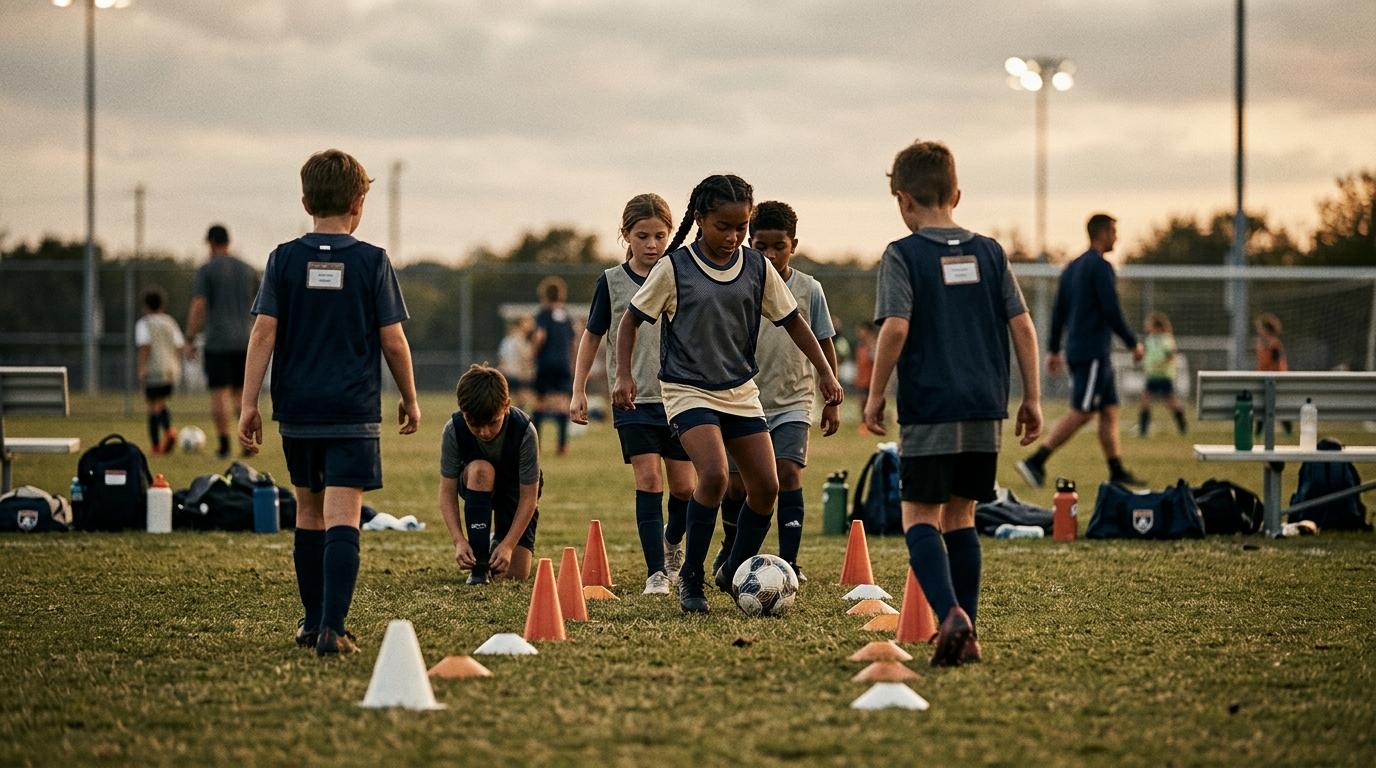

Two minutes before first whistle, one kid is tying a shoe, another is firing a ball at the fence, and three more are doing that half-jog-half-wrestle thing kids do when you said, very clearly, “Start warming up.” Meanwhile a parent asks, “Coach, are we stretching?” like there’s still time for a TED Talk.
That’s the moment a lot of practices get away from you. Not because the kids are bad. Not because you’re unprepared. Because loose starts create loose practices.
I learned this the hard way over a lot of seasons. If the opening minutes are vague, everything after that gets sloppier than it needs to be. Attention drifts. Energy goes sideways. You spend the next 40 minutes trying to pull the group back together. So I stopped leaving the warm-up to chance and started using the same 12-minute opening block almost every time.
Not fancy. Not sport-science theater. Just simple, repeatable, and easy for kids to learn.
Why this warm-up works
Kids do better when they know what’s coming. So do assistant coaches. So do the parents standing there wondering whether practice has actually started yet.
A good warm-up should do three things:
- Raise body temperature without wasting time
- Wake up basic movement skills
- Get kids listening and moving together
That last one matters more than people think. The warm-up is not just physical prep. It’s your first chance to set the tone.
Micro thought: The team that starts together usually practices better together.
The 12-minute structure
Minutes 0-3: Jog and move
Start with one easy lap or one defined jogging area, depending on age and space. Once they’re moving, layer in simple movement patterns on your whistle or call:
- Jog forward
- Side shuffle right
- Side shuffle left
- Backpedal
- High knees
- Butt kicks
Keep it moving. No standing in lines waiting for a turn to warm up. If they stop moving, you lose them.
For younger kids, I keep directions short and visual. “Show me quick feet.” “Turn and shuffle.” “Eyes up.” Long explanations in the first three minutes are practice killers.
Minutes 3-6: Dynamic stretches
This is where people overcomplicate things. You do not need 14 mobility drills with names nobody remembers. Pick a handful and do them the same way every time.
- Walking toe touches
- Quad pulls
- Lunges
- Open-and-close the gate
- Arm circles
- Trunk twists
I like moving stretches better than planting kids in one spot and hoping they take it seriously. They stay more engaged, and it feels more like sport.
If you coach little kids, they’ll rush. That’s normal. Slow them down without turning it into a lecture. “Balance.” “Control.” “Big step.” That usually does the job.
Minutes 6-9: Athletic movement
Now build in short competitive movement without making it a full drill yet. Think 5 to 10 yards, quick reps, lots of turns.
- Ready-position sprints
- Shuffle to sprint
- Backpedal to turn and go
- Short reaction races on a clap or point
This is where kids start to look awake. You’ll hear more chatter. Movements get sharper. The group starts feeling like a team instead of 11 separate arrivals.
I’ve coached enough to know this too: if you wait until the first “real drill” to ask for effort, you’re asking late. Effort should show up in the warm-up first.
Minutes 9-12: Ball or sport-specific touches
Finish with something connected to the sport so the transition into practice is smooth.
Examples:
- Soccer: partner passes, first touch, dribble turns
- Baseball/softball: quick glove work, wrist flips, footwork
- Basketball: pound dribbles, passing on the move, layup footwork
- Lacrosse: short passing, ground ball pickups, cradle moves
Nothing long. Nothing static. Just enough to connect the body warm-up to the actual session.
Micro thought: If the first ball touch is chaos, the next 20 probably will be too.
How to run it without sounding like a traffic cop
The best part of a repeatable warm-up is that eventually the team owns it. But that only happens if you keep your language simple.
Use short cues:
- “Find space.”
- “Eyes up.”
- “Move on the whistle.”
- “Control first, speed second.”
- “Next one sharper.”
A lot of new coaches talk too much at the start because they’re trying to sound organized. I’ve done it. Most of us have. But the warm-up gets better when your instructions get smaller.
Common mistakes
- Starting late because players are still arriving. Start anyway. Late arrivals can join. Waiting teaches the group that ready time is optional.
- Using the warm-up as punishment. Save the laps-and-groans routine. Warm-ups should prepare, not sour the mood.
- Making lines. If kids are standing, they are not warming up.
- Changing it every practice. Variety is fine later. Familiarity helps early.
I’ve seen teams with average talent and great structure look terrific by the middle of practice. I’ve also seen talented teams waste 15 minutes every day because nobody knew how things started.
That opening block matters. It tells kids, without a speech, that practice has a shape to it. It tells assistants where to jump in. It even calms the sideline a bit, because parents can see there’s a plan.
And maybe best of all, it saves you from that familiar beginning-of-practice scene where half the team is ready, half the team is wandering, and you’re already tired before the real work begins.
Build a warm-up they can learn. Run it the same way long enough for it to stick. Then watch how much cleaner the rest of practice feels.