Three minutes into the second quarter, one kid is at the scorer’s table, one is tying a shoe, and one is asking if they’re in or not. The ball is already live. You’re waving with one hand, talking with the other, and somehow the group on the bench still looks surprised a sub is happening. That’s not a talent problem. That’s a changeover problem.
I’ve seen this at every level of youth sports: kids don’t struggle with effort as much as they struggle with when and where. If the sub pattern lives only in the coach’s head, the bench turns into a guessing game. And guessing games get messy fast.
One of the simplest fixes is a 4-cone changeover drill. It teaches kids where to go, when to get there, and what to do before they ever hear their name in a game.
What the drill is
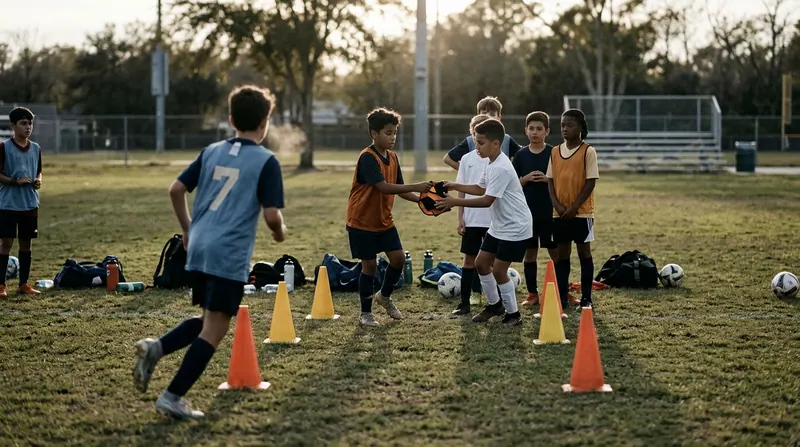
You’re setting four cones in a small box near your bench or sideline area. Each cone has a job. The whole point is to rehearse substitutions as a movement pattern, not as a speech.
- Cone 1: Ready spot — where the next player stands when they’re likely going in soon.
- Cone 2: Check spot — where they make eye contact with the coach and get the quick instruction.
- Cone 3: Entry spot — where they wait to sub in legally and calmly.
- Cone 4: Return spot — where the player coming out goes before sitting down, so you can connect fast and reset them.
That’s it. Four spots. No long explanation needed.
Why it works
Kids are better when the picture is clear. “Be ready” is fuzzy. “Get to Cone 1 when your line is up” is clear. “Listen for your turn” is fuzzy. “Stop at Cone 2 for your matchup or job” is clear.
I learned a long time ago that a lot of sideline chaos gets blamed on attention, attitude, or maturity when it’s really just bad traffic flow. If the path is sloppy, the sub is sloppy. If the sub is sloppy, the first 10 seconds after the whistle are sloppy too.
You don’t need louder reminders. You need a cleaner route.
How to teach it in practice
Take five minutes. Don’t wait until game day.
Step 1: Walk it
Pick four players. One is coming out, one is going in, two are waiting. Physically walk them through the cone pattern.
- Bench player moves from the team area to Cone 1.
- Coach sends them to Cone 2 for the quick job: “You’ve got left side.” “You’re in for defense.” “First pass simple.”
- Player slides to Cone 3 and waits under control.
- Outgoing player reports to Cone 4 before sitting.
Do it slow first. You’re building the map.
Step 2: Jog it
Now run the same sequence with pace. Add a whistle or a verbal cue. The incoming player has to move quickly without rushing past a spot. The outgoing player has to get off clean and report to the return spot.
This is where you catch the usual problems: kids drifting, kids stopping to talk, kids entering before they’re supposed to, kids coming out and disappearing straight to the water bottle.
Step 3: Add the ball
Once they know the route, add live play. Run a short scrimmage. Blow the whistle. Call a sub. Make them use the cones while everyone else resets.
Now it starts to look like a game instead of a diagram.
What to say at each cone
Keep the language short enough that a kid can hold onto it.
- Cone 1: “You’re next.”
- Cone 2: “Guard 12.” “Crash boards.” “Settle the ball.”
- Cone 3: “Wait here.”
- Cone 4: “Nice job. Breathe. You’re back in two.”
That’s plenty. The sideline falls apart when every sub becomes a seminar.
Clear spots make calmer kids.
Where coaches miss it
The mistake is thinking this only matters for starters or older players. It matters most for the kids who don’t naturally track the flow of the game yet. The unsure kid needs a place to stand. The excited kid needs a stop sign. The tired kid coming off needs one clean point of contact before the bench swallows them up.
I’ve coached enough games to know that substitutions can either settle your group or spread your stress. When the bench knows the routine, you stop burning energy on avoidable confusion. You can actually coach the game instead of chasing bodies around the sideline.
How to use it on game day
You don’t need to bring cones into every game if space is tight. Practice with cones so the pattern sticks. On game day, use landmarks: end of the bench, edge of the team box, scorer’s table, far chair, taped line, whatever the space gives you.
The drill is not about the cones. It’s about the order.
- Ready spot
- Check spot
- Entry spot
- Return spot
If the order stays the same, the kids settle in fast.
The real win
This won’t show up in a stat sheet. No parent is driving home saying, “What a beautiful substitution pattern tonight.” But they will feel the difference when the bench is calmer, the players are less scrambled, and your team starts the next stretch organized instead of half-late and half-confused.
That’s usually how good youth coaching works. It’s not always the big speech or the perfect play call. Sometimes it’s four spots on the ground and a team that finally knows where to go next.