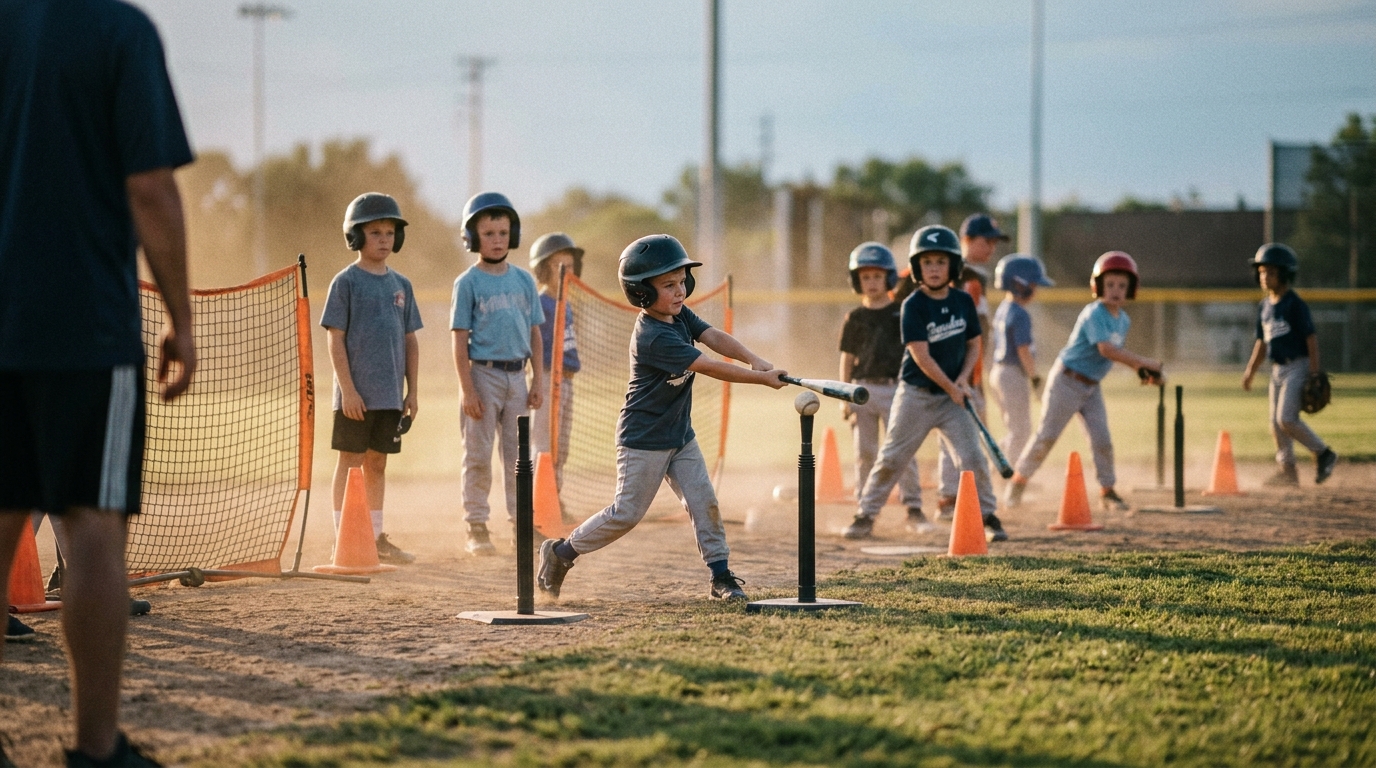
You’ve seen this one. One tee. Ten kids. Three are swinging, two are talking, one is digging a hole with a cleat, and the kid who actually needs reps is standing there getting cold while somebody’s dad says, “Eyes on the ball,” for the ninth time.
That’s not a hitting problem. That’s a setup problem.
I learned this the hard way years ago running youth practice with one cage, one bucket, and a group that got better at waiting than hitting. If kids have to stand too long, they drift. If they drift, the drill gets sloppy. Then the coach starts talking more than the players are working. Bad trade.
The fix is a simple 5-spot batting tee circuit. It gives kids more swings, shorter waits, and a cleaner flow without needing fancy equipment or a full staff.
What you need
- 1 or 2 batting tees
- 1 bucket of balls
- 5 clearly marked hitting spots
- Cones or flat markers
- A net, fence, or open field space
If you only have one tee, that’s fine. You can still run the circuit. The point is not perfection. The point is eliminating dead time.
How to set it up
Build five spots in a loose line or arc, each with a specific job.
Spot 1: Tee swings
This is the main work station. The hitter takes 5 to 6 game-speed swings off the tee. Not 20. Not until everybody else gets bored. Short round, real intent.
Spot 2: Load-and-hold dry swings
No ball here. Kids get into their stance, load, pause for a beat, then swing. This cleans up balance and keeps them moving while they wait.
Spot 3: Front-foot direction check
Put down a marker where the stride foot should land. The player works 5 reps stepping and landing under control. This is simple, but it saves a lot of spinning, reaching, and flying open.
Spot 4: One-hand finish reps
Dry swings again, but now the focus is finishing balanced. I like top-hand or bottom-hand finish feels depending on age, but for younger groups, just have them swing and freeze at the end.
Spot 5: Ball pickup and reset
This matters more than coaches think. One spot is just for collecting balls, refilling the tee area, and getting the next hitter ready. If you skip this, the whole thing jams up.
Every player rotates after a short set. Keep it moving. Nobody lives at one station.
How the rotation works
Put two kids at the tee spot if needed: one hitting, one feeding balls onto the tee. Everybody else starts at one of the dry-work spots.
On your whistle or voice cue, rotate. I like 30 to 45 seconds per station for younger kids and about a minute for older ones. Fast enough to keep energy up. Long enough to get a few quality reps.
If you’ve got 10 kids, you can pair them. One works, one watches for one simple thing: balance, eyes, or stride direction. Not a full hitting lecture. Just one job.
Good youth drills usually look a little boring on paper and a lot cleaner in real life.
What to coach and what to leave alone
Here’s where a lot of us make the drill worse. We start fixing everything.
Don’t do that.
Pick one theme for the whole circuit:
- Strong base
- Short path to the ball
- Balanced finish
- Staying through the middle
Then coach that theme across all five spots.
I’ve stood next to enough tee stations to know this: the more words you pour into a kid mid-round, the less athletic the next swing gets. Let them work. Give one cue. Watch the next rep.
Why this works better than a single tee line
Kids stay warmer. They get more total movement. They stop treating batting practice like a checkout line.
And for the coach, it changes the tone of practice. Instead of spending 15 minutes saying, “Back up, wait your turn, quit messing around,” you get to actually teach hitting.
That’s the part newer coaches sometimes miss. Structure is instruction. If the drill is organized, kids usually behave better without a behavior speech.
I’ve used this with rec teams, mixed-skill groups, and practices where half the roster showed up late with a granola bar still in hand. It holds up because it’s simple. Kids know where to go next. Coaches know what they’re looking for.
Common mistakes
- Rounds that are too long. Short rounds keep focus up.
- Too many coaching cues. One theme is enough.
- No reset station. Then the tee area turns into a scavenger hunt.
- Kids standing empty at dry stations. Give each spot a clear job, not just a place to wait.
- Using the best hitter as the example for every rep. Spread the turns. Everybody needs swings.
Best age for it
This works especially well for youth baseball and softball players who are old enough to rotate independently but still young enough to lose focus in a long line. That’s a wide range, honestly.
If the group is very young, cut it to three spots instead of five. Same idea. Less traffic.
If the group is older, make the stations more specific and raise the pace.
Either way, the lesson is the same. A tee is not just a piece of equipment. It’s a chance to build a practice segment where kids are active instead of idle.
And idle is where a lot of bad practice starts.