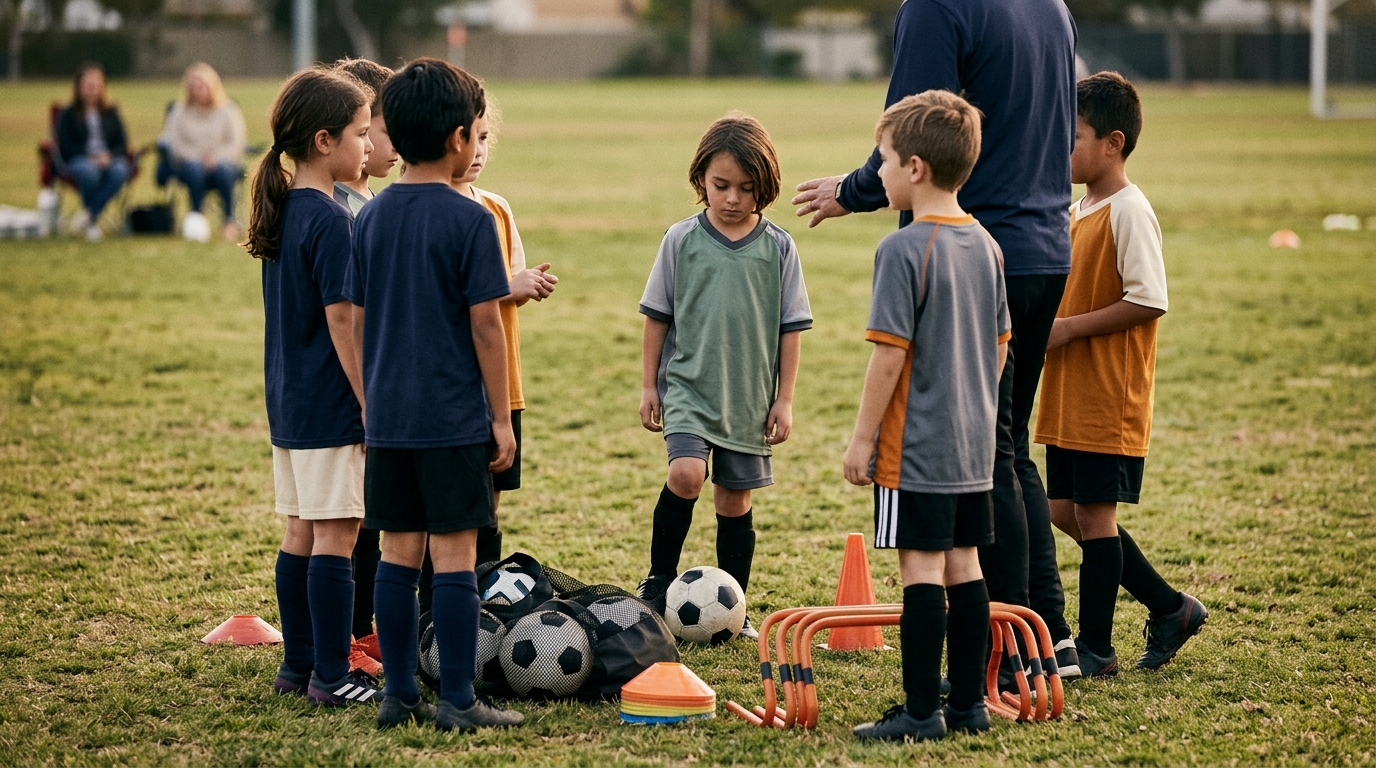

Two minutes into practice, six kids were chasing one ball like it owed them money. One player was wide open near the sideline, arms out, doing the universal youth-sports gesture for I am begging you to look up. Nobody saw her. A parent laughed. An assistant coach started explaining spacing from thirty yards away. The kids kept bunching anyway.
That’s the moment a lot of coaches start talking too much.
I’ve done it too. You stop practice, give a smart little speech about width and angles, and every kid nods like they understand. Then the ball moves again and they all run back into the same five-foot patch of grass.
Kids usually don’t need a better lecture. They need a picture they can stand inside.
That’s why I like a cone grid.
It’s simple, fast, and works in just about any invasion game where kids need to learn how not to crowd each other. Soccer, lacrosse, basketball, hockey in dry-land form, even flag football footwork and movement concepts. You’re not teaching a chalkboard lesson. You’re giving them boundaries they can feel.
Set up the grid
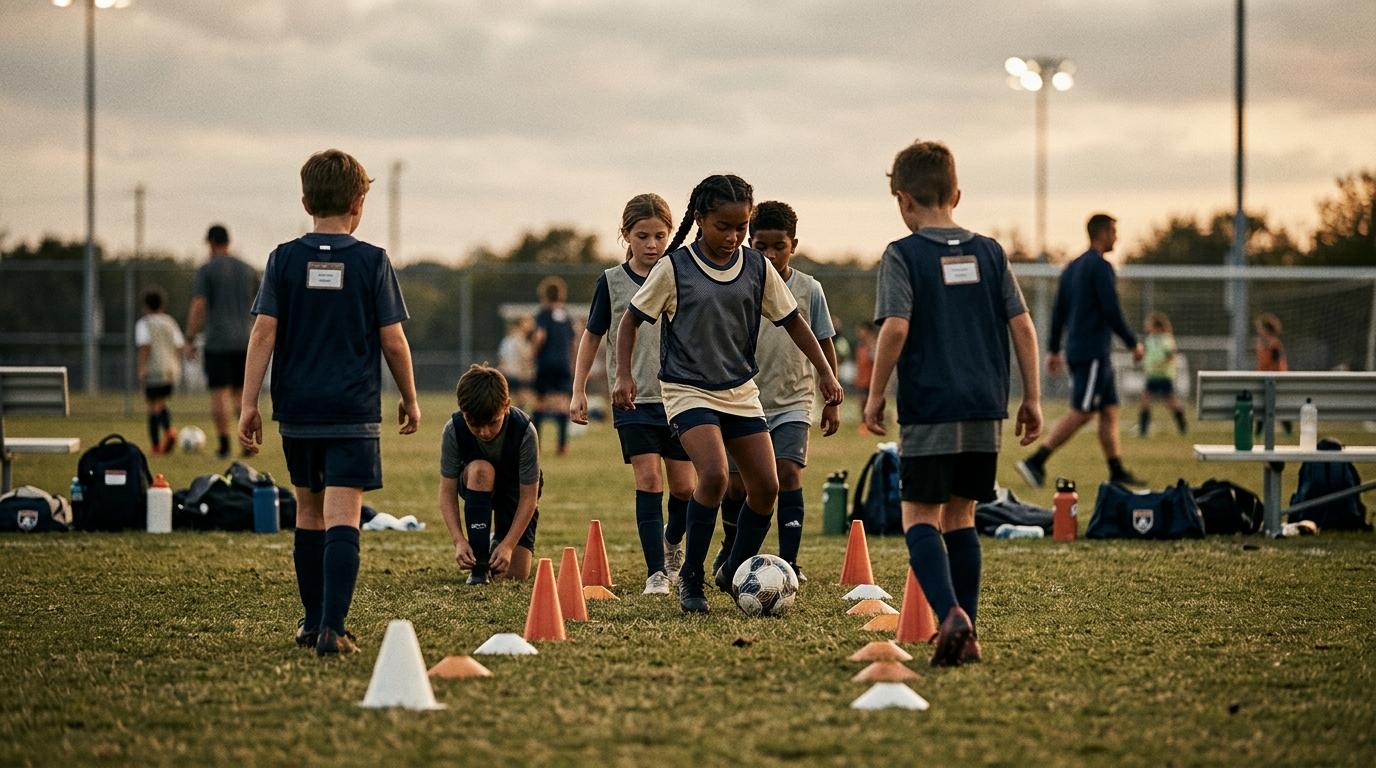
Use cones to make a rectangle, then divide it into smaller boxes. For younger kids, start with a grid that gives everybody room. If you’ve got 8 players, make 6 to 9 boxes. You don’t need exact measurements. You just need visible space.
- 4 corner cones for the outside
- 4 to 8 more cones to split the area into boxes
- One ball
- Pinnies if you’re going team versus team
If your sport uses sticks or feet, the same rule applies: one player per box to start. That’s the whole point.
When kids can see spacing, they stop hearing it as an abstract idea.
Start with the easy version
Put one player in each box. The rule is simple: don’t leave your box.
Now move the ball. Pass, receive, pivot, scan, move it again.
That first round matters because it cleans up the chaos. Instead of everybody drifting toward the ball, they start learning that being available somewhere else is useful.
For younger players, I’ll say it like this: “If two teammates are standing in the same box, one of you is making life harder.”
That usually lands.
Run this for short bursts, maybe 30 to 45 seconds. Then freeze them and ask one question: “Who made the last pass easier?” Not who scored. Not who’s fast. Who created space and helped the next decision.
That’s a better habit to reward early.
Then add movement
Once they get the shape, let them move to a new box after they pass. Now they’re learning timing instead of just standing in spots.
Keep the correction tight:
- Pass, then replace open space
- Don’t follow your pass into traffic
- If your teammate enters your box, clear out
- Look away from the ball before the ball gets to you
You’ll start seeing it click. One kid checks out of a crowded area. Another slides into the empty box. Suddenly the field doesn’t look like recess anymore.
Good spacing is just decision-making made visible.
Turn it into a competitive drill
Now split into two teams if numbers allow. One team keeps possession. The other defends, but still has to respect the grid rules based on your age group and goal.
Easy scoring options:
- 1 point for five clean passes
- 1 point for switching the ball from one side of the grid to the other
- 1 point for receiving in an empty box after a pass
If the defenders keep winning because the space is too small, enlarge the grid. If the offense has it too easy, shrink it a little or allow defenders to pressure more freely.
This is where coaching experience matters: don’t force the perfect setup on the first try. Read what the drill is giving you.
If kids can’t complete anything, they’re not learning spacing. They’re just surviving.
What to say during the drill
Most coaches say too much here. Try using the same few cues over and over.
- “Find the empty box.”
- “Help before they’re stuck.”
- “Wider, not closer.”
- “Pass and move somewhere useful.”
That’s enough. You do not need a TED Talk between reps.
On the sideline, you can usually tell when a drill is working by who stops talking. The assistant quits explaining. The parents go quiet. The kids start solving it themselves.
Common mistakes
Making the grid too tight
If every box is crowded from the start, you’ve built a traffic jam and called it development.
Letting the best player cheat the concept
That one strong kid who wants to roam everywhere and rescue every rep? Useful in games, maybe. Bad for learning this skill. Keep the rules honest.
Keeping it too static for too long
The no-leaving-your-box version is a teaching tool, not the whole practice. Use it, then progress.
Correcting only the player with the ball
Most spacing problems come from the players without it.
The open teammate is part of the play, even when they never touch the ball.
Where it fits in practice
I like this after a quick dynamic warm-up and before scrimmage. It sharpens eyes and feet without a line of kids waiting their turn.
A clean structure looks like this:
- 5 to 8 minutes dynamic movement
- 10 to 12 minutes cone grid progression
- 10 minutes directional possession or small-sided play
- Finish with game play where you watch for transfer
And that last part matters. If the spacing disappears the second you remove the cones, don’t get dramatic. That’s normal. Bring the cues with you into the scrimmage.
Because this is the real coaching job: build something simple enough that kids can carry it into a messy game.
The bunching won’t vanish overnight. Youth players are drawn to the ball. They always will be. But once they’ve felt what real spacing looks like, the field starts opening up. Passes come earlier. Decisions get cleaner. The whole game gets less noisy.
And best of all, you stop having to shout, “Spread out!” every fourteen seconds like it’s a personality trait.